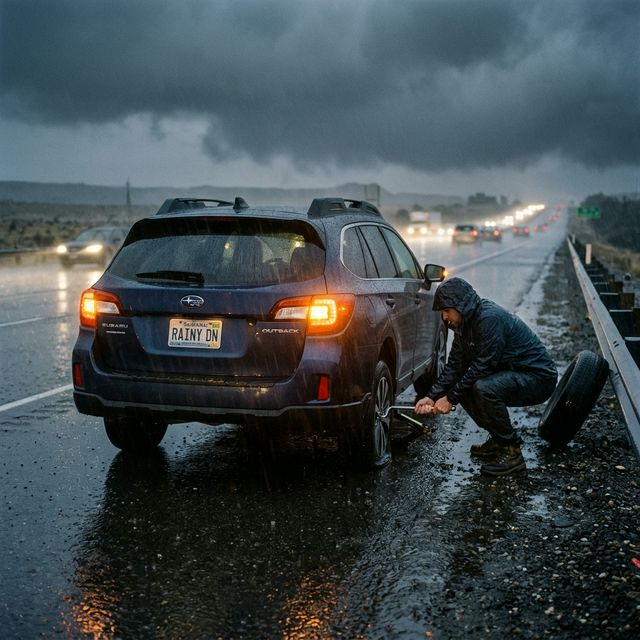
1. Prioritize Safety and Visibility Above All Else
When the rain is coming down in sheets, other drivers will experience drastically reduced visibility, making it much harder for them to see a disabled vehicle on the shoulder of the road. Your first priority should not be your tire, but rather your absolute safety and maximizing your visibility to oncoming traffic.
Find a Safe, Solid Location
Rain creates mud, and mud is the enemy of a car jack. If you attempt to jack up a heavy vehicle on a soft, muddy, or entirely unpaved surface that has been compromised by heavy rain, the jack will likely sink into the soil. This can cause the car to fall off the jack, potentially leading to catastrophic damage or severe personal injury. You must limp your car to a solid, paved location—like an underpass, a wide asphalt shoulder, a nearby gas station, or a well-lit parking lot.
Maximize Your Vehicle's Visibility
Immediately turn on your hazard lights. If you carry emergency warning triangles or roadside flares in your trunk (which is highly recommended in any thorough car maintenance guide), this is the optimal time to deploy them. Place them several dozen yards behind your vehicle to give approaching drivers ample warning to slow down and move over.
2. Assess the Tools You Have Available
Before you step out into the rain, locate your spare tire, jack, and lug wrench. If you have any rain gear—an umbrella, a poncho, or even just a thick jacket—put it on. A waterproof flashlight or a headlamp is an absolute game-changer here, as the heavy cloud cover often makes the environment dark and dreary.
3. Step-by-Step: How to Change a Tire in the Rain
With safety measures in place, you are ready to begin the physical work. You need to work quickly but deliberately, never sacrificing safety for speed.
- Loosen the Lug Nuts: While the car is still firmly resting on the ground, use your lug wrench to loosen the lug nuts. Do not take them off completely; simply break the seal. The rain makes everything slippery, so ensure you have a firm grip on the wrench. If the nuts are too tight, use your body weight, but use caution not to slip in the wet conditions.
- Position the Jack: Find the factory-recommended jacking points under your vehicle. Because everything is slick with water, you must be absolutely certain that the jack is making solid, flush contact with the metal frame. Double-check its stability before applying lifting force.
- Lift the Car: Safely pump the jack until the flat tire is completely off the ground and there is enough clearance to put the fully inflated spare tire onto the wheel hub.
- Swap the Tires: Completely remove the loosened lug nuts. Carefully pull the wet, heavy flat tire off the hub. Lay it flat on the ground so it doesn't roll into traffic. Lift your spare tire onto the lug bolts.
- Hand-Tighten the Lug Nuts: Thread the lug nuts back onto the bolts by hand. This prevents cross-threading, which is an easy mistake to make when your hands are cold, wet, and shivering.
- Lower the Vehicle and Torque: Lower the car back down to the pavement. Using your lug wrench, tighten the lug nuts in a star or criss-cross pattern. This ensures that the spare tire is mounted evenly.
4. Additional Flat Tire Tips for Wet Weather
When executing these steps, remember that wet brakes and wet tires perform very differently. Your spare tire (often a smaller "donut") has vastly reduced traction compared to a standard tire. When driving in the rain on a spare tire, you must reduce your speed significantly. Most manufacturers recommend driving no faster than 50 mph on a spare tire, but in the rain, you should reduce that to 35-40 mph to actively avoid hydroplaning dynamics.
If you find that the rain is simply too intense, there is absolutely zero shame in staying inside the vehicle and calling for roadside assistance. A skilled tow truck driver has the equipment and the high-visibility gear required to tackle the job with much less risk. For more detailed safety statistics and advice on wet weather conditions, we recommend reviewing the AAA Wet Weather Driving Tips.
Conclusion
Knowing how to change a tire in the rain is all about preparation, maximizing your visibility, finding a solid paved surface, and carefully managing slippery tools. By keeping these top-tier flat tire tips and this car maintenance guide in mind, you can conquer this stressful roadside emergency, stay safe, and get back on your journey with absolute confidence.