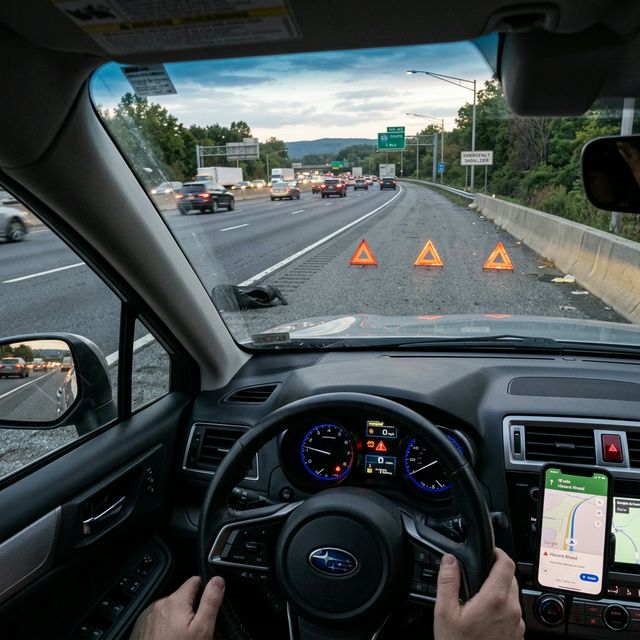
Emergency Tip #1: Do Not Slam on the Brakes
It is human nature to instinctively mash the brake pedal when something goes drastically wrong with a vehicle. However, heavily applying the brakes during a blowout is the single worst thing you can do.
When a tire loses all internal pressure and begins to aggressively shred, that specific corner of the car loses its traction and behaves completely differently than the other three rolling wheels. If you brake hard, the car will violently pull toward the side of the blown tire, which can easily induce a severe spin or even a vehicular rollover. Instead, you should simply take your foot entirely off the accelerator. Maintain a firm grip on the steering wheel, hold your trajectory straight, and allow the car to gradually lose momentum through engine braking and drag before you apply light, balanced pressure to the brakes.
Emergency Tip #2: Don't Stop in the Middle of Traffic
Many drivers panic when the tire goes flat and simply bring the car to a halt wherever they happen to be in the lane. Stopping in active lanes of traffic on an interstate or busy highway presents an astronomical risk of causing a catastrophic rear-end collision.
One of the most important flat tire tips: do not worry about damaging the rim. If your tire is completely flat, the rim is already riding on the rubber or straight on the asphalt. It is much better to slowly limp the car on a ruined rim or tire carcass onto a wide shoulder, an exit ramp, or an adjacent parking lot than it is to stop in traffic. Your life is vastly more valuable than a replaceable steel or alloy wheel rim.
Emergency Tip #3: Ensure the Environment Is Safe
Once you have moved the vehicle slowly onto the shoulder or a safe spot, do not jump out of the door immediately. Evaluate the environment around you. It isn't time to jump out and learn how to change a tire right there if the environment is hostile.
- Traffic Proximity: Are semi-trucks flying past your driver's door at high speeds? If so, and the flat tire is on the driver's side, you cannot safely change the tire there. You must call for a tow or professional roadside assistance. They will arrive with heavy strobe lights and large blocking vehicles.
- Surface Level: Is the ground where you pulled over slanting dramatically into a deep ditch? If you employ a jack on a steep incline, the car will almost certainly tip off the jack and crash down—potentionally onto you. If the spot isn't safe, limp the car further ahead until you find a wide, flat, stable surface.
Emergency Tip #4: Turn on Hazard Lights Down Immediately
The moment you suspect a flat tire, hit your hazard light button. Not only does this inform the cars directly behind you that you are rapidly slowing down, but it also signals other drivers to give you a wide berth once you are pulled over. If you have hazard cones or emergency warning triangles stashed in your trunk, set them up. An integral part of any complete car maintenance guide is keeping a high-visibility reflective vest in your glovebox; put it on before working around the car.
Emergency Tip #5: Evaluate Your Tools and Capability
Once safe, assess the situation calmly. Do you possess a spare tire, or did your car only come with an emergency inflation kit (like a can of aerosol sealant)? Do you know definitively how to change a tire? Do you have a functional jack and a properly sized lug wrench? Has it been ten years since the spare tire was checked, meaning the spare itself might be deflated?
There is absolutely no shame in determining that you are simply not equipped to deal with the situation safely. If the conditions are dark, rainy, incredibly close to high-speed traffic, or if your tools are rusted or missing, call for professional help. Paying for a tow is far better than risking your personal well-being on an unstable jack near heavy machinery. For an additional comprehensive breakdown, we highly recommend reading Consumer Reports' official guide on managing flat tire scenarios.
Conclusion
A blowout is frightening, but keeping a cool head is your best defense. By refraining from hard braking, pulling over completely, establishing a safe workspace, maximizing your visibility, and honestly assessing your capability to swap the tire, you dramatically reduce the danger of the situation. Make sure to frequently consult our car maintenance guide and stock your vehicle to be prepared to utilize these flat tire tips on every journey.